Close Menu
    Facebook X (Twitter) Instagram
    ScienceMotive
    • Class 9
      • Matter in Our Surroundings
      • Is Matter Around Us Pure
      • Atoms and Molecules
      • Structure of the Atom
      • The Fundamental Unit of Life
    • Class 10
      • Chapter 1: Chemical Reactions and Equations
      • Chapter 2: Acids, Bases & Salts
      • Chapter 3: Metals & Non-Metals
      • Chapter 4: Carbon and its Compounds
      • Chapter 5: Periodic Classification of Elements
      • Chapter 6: Life Processes
      • Chapter 7: Control and Coordination
      • Chapter 8: How Do Organisms Reproduce?
      • Chapter 9: Heredity and Evolution
      • Chapter 10: Light – Reflection and Refraction
      • Chapter 11: Human Eye and the Colourful World
      • Chapter 12: Electricity
      • Chapter 13: Magnetic Effects of Electric Current
      • Chapter 14: Sources of Energy
      • Chapter 15: Our Environment
      • Chapter 16: Management of Natural Resources
    • Class 11
      • Chemisrty 11
        • Chapter – 1 Some Basic Concepts of Chemistry
        • Chapter – 2 Structure Of Atom
        • Chapter – 3 Classification of Elements and Periodicity in Properties
        • Chapter – 4 Chemical Bonding and Molecular Structure
        • Chapter – 5 States of Matter
        • Chapter – 6 Thermodynamics
        • Chapter – 7 Equilibrium
        • Chapter – 8 Redox Reaction
        • Chapter – 10 s-Block Elements
        • Chapter – 13 Hydrocarbons
    • Class 12
      • Chemistry 12
        • The Solid State
        • Solutions
        • Electrochemistry
        • Chemical Kinetics
        • Surface Chemistry
        • p – Block Elements
        • d & f Block Elements
        • Coordination Compounds
        • Haloalkanes and Haloarenes
        • Alcohols, Phenols and Ethers
        • Aldehydes, Ketones and Carboxylic Acids
        • Amines
        • Biomolecules
        • Polymers
        • Chemistry in Everyday Life
    • Practice Questions
      • +1
      • +2
    • Test Series
      • Class 9 Test Series
      • Class 10 Test Series
      • Class 11 Test Series
      • Class 12 Test Series
    • World
      • Current Affairs
      • General Knowledge
    ScienceMotive
    Home » Answers Subjective Assignment Chemical Reactions and Equations

    Answers Subjective Assignment Chemical Reactions and Equations

    Dr. Vikas JasrotiaBy Dr. Vikas JasrotiaOctober 3, 2020Updated:June 7, 2023No Comments
    Share
    Facebook WhatsApp Telegram Twitter Email

    Answers Subjective Assignment Chemical Reactions and Equations

    Ans 51. When lime water sticks on walls react with CO2 of air to forms a layer of CaCO3 which is white in colour.   

    Ans 52. Both burning of Fuel and food are oxidation reaction, in burning of fuel CO2 and heat is released and in burning of Food, A.T.P. energy and CO2 are formed.

     Ans 53. Rusting is avoided in stainless steel because it is an alloy.

     Ans 54. In the cracker explosion, on burning fuel or material like charcoal, sulphur or potassium chloride reacts with oxygen in an oxidation reaction.  

     Ans 55. Iron is coated with zinc to protect it from direct contact of air and moisture to avoid rusting.

     Ans 56. Platinum is a noble metal and has placed right to hydrogen, hence do not react with dilute sulphuric acid.

     Ans 57. In the reaction of BaCl2 (aq) with NaCl(aq), BaSO4 (s) precipitate is formed which is heavy and insoluble in water

    Ans 58. Yes, the silver nitrate solution reacts on heating with copper metal powder to form silver metal.

     Ans 59. Magnesium plate provides electrons and avoids oxidation of Iron metal to protect heavy machines from rusting.

    Ans 60. (i) Ferrous sulphate (FeSO4)
    (ii) Decomposition reaction.
    (iii) Ferric oxide (Fe2O3)
    (iv) Sulphur dioxide (SO2)
    (v) 2 FeSO4(s) + heat  →  Fe2O3(s) + SO2(g) + SO3 (g) 

    Ans 61. Fe2O3(s) + 2 Al(s) → Al2O3(s) + 2 Fe(s) 
    Use – To weld/join railway tracks.

    Ans 62. Balanced equations are:
    a). Al2(SO4)3 + 6 NaOH → 2 Al(OH)3 + 3 Na2SO4
    b). 2 Cu2S + 3 O2 → 2 Cu2O + 2 SO2
    c). AlN + 3 H2O → Al(OH)3 + NH3

    Ans 63. (i) Nitrogen dioxide (NO2).  
    (ii) 2 Pb(NO3)2(s)  +  heat →  2 PbO(s) + 4 NO2(g) + O2(g) 
    (iii) Lead monoxide (PbO).

    Ans 64. Respiration is the oxidation of food, during this process, energy is released as given in the following equation.  C6H12O6 + 6 O2   →    6 CO2 + 6 H2O + energy. Thus, it is an exothermic reaction.

    Ans 65. A yellow precipitate of lead iodide is formed.  

    Answers Subjective Assignment Chemical Reactions and Equations (Balancing the equations)

    Ans 66. Balanced equation with reactant and products:
    (i) 2 NaCl (aq) + Current  →  2 Na(s) + Cl2(g) 
    (ii) Mg(s) + 2 HCI(aq)    →  MgCl2(s) + H2(g) 
    (iii) KCIO3(s)  +  heat    →   KCI(s) + O2 (g) 
    (IV) BaCl2(aq) + Na2SO4(aq)  →   BaSO4(s) + 2 NaCl(aq)
    (V) Fe(s) + CuSO4(aq) →  FeSO4(aq) + Cu(s)

    Answers Subjective Assignment Chemical Reactions and Equations (Balancing the equations)

    Subjective Assignment Chemical Reactions and Equations

    Advertisement
    Answers Subjective assignment Chemical Reactions And Equations
    Share. Facebook Twitter Pinterest LinkedIn Tumblr Email
    Dr. Vikas Jasrotia
    • Website

    Related Posts

    Carbon and Its Compounds

    January 23, 2023

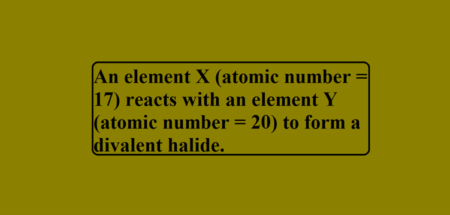
    An element X (atomic number = 17) reacts with an element Y (atomic number = 20) to form a divalent halide.

    January 10, 2023

    Mendeleev Periodic Table PDF

    March 4, 2022
    Leave A Reply Cancel Reply

    READ ALSO

    Haloalkanes And Haloarenes-

    February 9, 2026

    Organic Explanations

    September 8, 2025

    Thermodynamics PDF

    June 3, 2024

    States of Matter Class 11 Notes PDF

    May 30, 2024
    +2

    Haloalkanes And Haloarenes-

    By Dr. Vikas JasrotiaFebruary 9, 2026

    Haloalkanes And Haloarenes Read the given passage and answer the questions below: Passage – 1:…

    +2

    Organic Explanations

    By Dr. Vikas JasrotiaSeptember 8, 2025

    Organic Chemistry Important Explanations Organic Explanations S.No 1 Bond enthalpy decreases as: CH3-F > CH3-Cl…

    Class 11

    Thermodynamics PDF

    By Dr. Vikas JasrotiaJune 3, 2024

    THERMODYNAMICS PDF THERMODYNAMICS PDF Introduction Chemical thermodynamics deals with the relationship between various forms of…

    Advertisement
    Advertisement
    Facebook X (Twitter) Instagram Pinterest YouTube
    • Disclaimer
    • Contact Us
    • Privacy Policy 
    • Terms and Conditions
    © 2026 All Rights Reserved ScienceMotive.

    Type above and press Enter to search. Press Esc to cancel.